
Why Community Housing is Ontario’s Social Infrastructure Engine
Imagine building every car in the world as a G-Wagon. You’d end up with a lot of people walking to work. In many ways, that’s what Ontario’s housing system is doing today: producing housing at a price point many tenants cannot afford.
That analogy, from Andrew McKenzie, Director of Operations at ONPHA, cuts right into the heart of Ontario’s housing crisis. While billions flow into market-rate development, the housing most Ontarians actually need – deeply affordable, community-rooted, long-term housing – is disappearing faster than it’s being built.
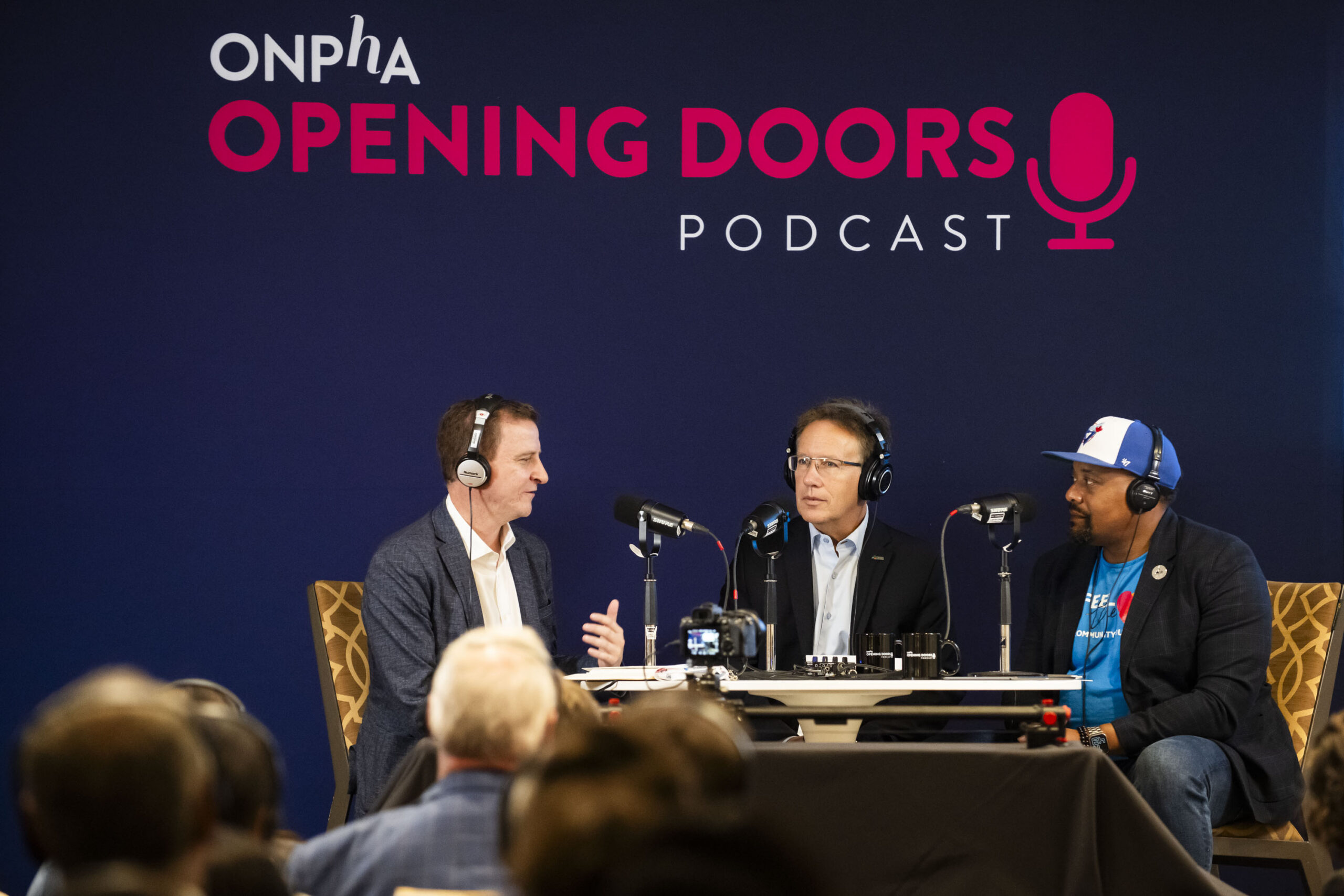
In the Season 3 premiere of ONPHA’s Opening Doors Podcast, Sean Baird, CEO of Toronto Community Housing Corporation (TCHC), and Stéphane Giguère, CEO of Ottawa Community Housing (OCH), joined McKenzie for a candid, wide-ranging conversation about the sector’s identity, its economic weight, and the urgent need to shift from asking for dollars to deploying them.


Building the Right Supply
Ontario’s challenge isn’t just that we’re not building enough housing. It’s that the housing being built isn’t reaching the people who need it most.
Consider the scale of what already exists. Toronto Community Housing alone manages a portfolio valued at over $15 billion and houses 110,000 tenants across every neighbourhood in the city. Ottawa Community Housing supports 33,000 tenants across the capital. Together, their combined portfolios represent $25 billion in assets, and that’s just two providers.
Historically, the sector was built to serve the lowest 20% of income earners. Today’s affordability crisis has changed that, pulling middle-income earners into the mix and pushing that number closer to 50%, with no corresponding increase in supply.
Community housing organizations are the only ones mandated and structured to meet that need. The question is whether they’ll be given the conditions to do so.
$38 Billion in Public Assets
Across the province, more than 260,000 households live in community housing, making it one of Ontario’s most important housing systems for low- and moderate-income tenants. Ontario’s community housing providers collectively manage roughly $38 billion in assets. Many of these properties are reaching the end of their mortgage terms, creating a once-in-a-generation opportunity to refinance, leverage equity, and deploy capital into new development.
Nobody questions whether Ontario needs new roads. Nobody asks whether bridges should be funded by grants or loans. Infrastructure is funded through sustained, long-term public capital, because the cost of not having it is understood to be catastrophic.
Community housing deserves the same assumption of necessity. These buildings have existed for 40, 50, or even 100 years, and they will be here 100 years from now. No private developer can offer that kind of perpetuity alongside a guaranteed social return.
Reframing community housing as infrastructure has real policy implications. It means shifting away from grant-by-grant project funding to capital-matching frameworks that allow the sector to deploy at scale and speed. It means trusting a sector that has already demonstrated it can responsibly steward $38 billion in public assets.
It’s a call for the sector to start operating like the growth industry it already is.
Beyond the Landlord Role
Community housing serves a wide range of households, including working families, seniors, and others who rely on affordable housing to remain in their communities. At the same time, providers are increasingly supporting tenants who require additional supports. Since the COVID-19 pandemic, mental health and addiction challenges have become more visible across the province, meaning the role of community housing often extends beyond traditional property management.
Community housing providers are landlords, yes, but they are also community builders and social service connectors. They absorb complexity that other systems cannot handle, often without the resources to do so.
The answer isn’t for community housing to do everything alone. It’s to partner, collaborate, and integrate. Hospitals recognize that patients need stable housing before they can be safely discharged. Other sectors are stepping in to build housing because the gap is so acute.
Community housing providers are the organizations best positioned to lead this work, if they are supported to do it.
The Economic Engine
When a community housing provider announces a new development, it isn’t just announcing housing. It’s announcing jobs: construction workers, tradespeople, support staff, and the economic ripple created when those workers spend in their local communities. That’s what infrastructure does. And that’s the language the sector needs to use.
OCH currently has around 2,000 units in its development pipeline. The economic impact of that construction activity alone is estimated roughly to be 10,000 jobs and $1.5 billion in economic activity. And that’s just in Ottawa.
Scale that across Ontario and the impact is hard to ignore. Every dollar not invested in community housing shows up somewhere as a much larger cost, whether in emergency shelters, hospitals, or the justice system.
Community housing is preventative infrastructure, and it’s far more cost-effective than the reactive alternatives.
Seizing the Moment
Both Baird and Giguère were candid about the sector’s past. Older model community housing often concentrated poverty through dense, isolated developments with limited integrations into surrounding neighbourhoods. Some of those challenges are still visible today.
But the sector has evolved. Today’s developments prioritize mixed-income communities, integrated supports, and thoughtful urban planning.
At the same time, providers face a dual challenge: renewing aging housing stock while building new supply. The sector has spent years developing plans and solutions. What it needs now is the ability to move at the pace the crisis demands.
A Sector That Grows Together
Smaller non-profits shouldn’t have to face development alone, and with the right coordination, they won’t have to.
Giguère pointed to a model from banking: syndication. When a major construction firm borrows $500 million, no single bank carries the full risk. They call each other, share the loan, and distribute the exposure. The community housing sector could operate in a similar way.
Large providers like TCHC and OCH can share knowledge, risk frameworks, and even capital with smaller non-profits, lifting the sector’s capacity without requiring mergers or loss of autonomy. The goal isn’t to turn every small non-profit into a major developer. It’s to create the conditions where a 50-unit provider can participate in the growth of a 500-unit project.
This would require a shared inventory of who owns what assets, what’s coming off mortgage, and who needs what and when. It requires a framework for collaboration that doesn’t yet exist, but that the sector is ready to build.
An Unmatched Investment Pitch
Community housing offers something few investments can match: permanence.
Non-profit housing stock has supported Ontarians for generations and will continue to do so for generations to come. It keeps workforces housed, prevents hospitals from being overwhelmed, and helps cities remain economically competitive.
Unlike rent supplements that erode with inflation, a community housing unit becomes more valuable over time. This is what makes non-market housing Ontario’s best investment: every dollar spent today builds a legacy of stability for the next generation, without a built-in profit margin driving up costs.
[We are offering the best return on investment] because of the perpetuity of the stock we are committing to.
We were there, we will be there…And we are there because we care.
– Stéphane Giguère, OCH
The sector has the plan. It has the assets. It has both the moral case and the economic case. What it needs now is to be taken seriously as the critical infrastructure it has always been.
Ontario needs community housing. It’s time to act like it.
To see specific policy recommendations and roadmap for the sector, explore ONPHA’s Community Housing Advocacy strategy.
Dive Deeper
Listen to the full conversation on the Opening Doors Podcast, Season 3, Episode 1: Made in Housing. Then join us this Fall at the 2026 ONPHA Conference in Toronto to keep building on the conversation.