
Municipal Election Tool Kit
Local decisions help shape the future of community housing, from funding and local priorities to land use and planning approvals. This toolkit is designed to support your engagement in the upcoming 2026 municipal election process, keep you informed on key issues, and help elevate the voices of the communities you serve.
Understanding Ontario’s Housing System: Who Does What?
Local Government Roles in Housing & Homelessness
Housing and homelessness are shared responsibilities. Local municipalities and Service Managers each play distinct but complementary roles in planning, funding, and supporting housing solutions in their local communities. Understand some of the key responsibilities of each.
Municipal Roles
Municipalities play a central role in shaping the local conditions that allow housing to move forward. Depending on local governance structures, municipalities may be involved in:
- Local housing strategies and growth planning;
- Land use planning and zoning, including Official Plans, site plan approvals, etc.;
- Infrastructure and servicing;
- Development charges, fees, incentives, and community improvement plans;
- Community engagement and public consultation; and
- Municipal surplus land identification and disposition.
Municipalities can also create the conditions for constructive housing conversations by providing clear information, setting expectations for respectful engagement, and communicating the public interest in expanding affordable and supportive housing options.
Service Manager Roles
In Ontario, 47 designated Service Managers play a key role in the local housing and homelessness system. Depending on the geography, a Service Manager may be an upper-tier regional government, a standalone single-tier city, or a District Social Services Administration Board in the north. Their responsibilities may include:
- Administering community housing programs;
- Managing centralized waiting lists;
- Developing and implementing local housing and homelessness plans;
- Funding and coordinating homelessness prevention activities;
- Supporting emergency shelter, transitional housing, and supportive housing partnerships;
- Working with non-profit housing providers, Indigenous housing organizations, and community agencies;
- Allocating provincial and federal housing program funding;
- Collecting local housing and homelessness data; and
- Coordinating system planning across municipal, regional, rural, and northern contexts.
Service Managers are important partners in identifying local housing needs, aligning housing investments, supporting non-profit housing providers, and where applicable, helping their local municipalities understand how individual developments fit within broader housing and homelessness system planning.
A list of service managers in Ontario can be found here.
Indigenous Program Administrators (IPAs) operate using a similar model (see the Housing Program Partners & Their Roles example below).
Housing Program Partners & Their Roles
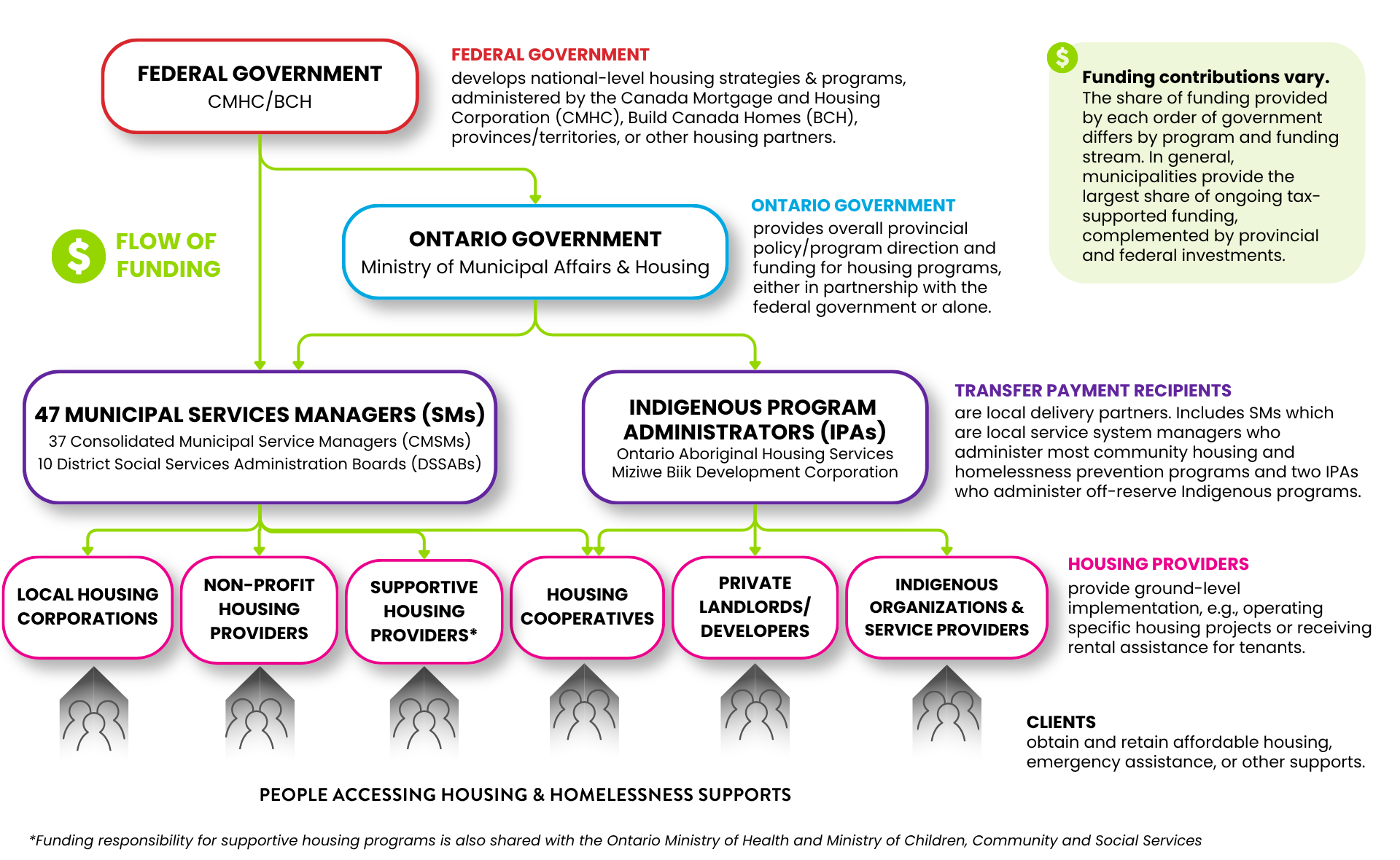
The housing system involves many partners, each with a distinct role. The chart below illustrates how responsibilities are shared across the housing and homelessness system, from federal policy and funding decisions to provincial oversight, municipal administration, local service delivery, and ultimately the housing and supports provided to people in need.
Community housing providers are funding partners. Rent revenue and other locally generated income help offset operating costs that are not covered by government funding.
Community housing is a cost-saving investment. Stable, affordable housing reduces reliance on higher-cost public services, including health care, emergency shelters, social services, and the justice system.
Current Challenges
Housing affordability and homelessness remain among the most pressing and interconnected challenges facing Ontario municipalities.
While growth, infrastructure, and affordability continue to dominate municipal dialogue, housing and homelessness challenges are increasingly viewed as symptoms of broader structural pressures that local governments are being asked to manage without sufficient funding or support from senior levels of government.
As a result, housing and homelessness pressures are not only social challenges but have also become significant financial and operational challenges for municipalities.

Housing Challenges
Municipalities consistently identify housing as a top local concern, not just the number of homes being built, but the lack of affordable and deeply affordable options.
Although price growth has moderated in some areas, affordability remains out of reach for many households, particularly lower-income and vulnerable residents. At the same time, municipalities are balancing growth with infrastructure constraints and community concerns about intensification and development.

Homelessness and Social Pressures
Municipalities are increasingly on the front lines of responding to homelessness, mental health, addictions, and related social challenges—areas traditionally supported by other levels of government.
Over the past decade, homelessness has become more visible and persistent in many communities. As pressures grow, municipalities are also managing rising public concern alongside limited system capacity and resources.
Advocacy Priorities for Municipal Audiences

Grow the sector to respond to affordability pressures, population growth, and homelessness.
- Create a community housing fast-track for non-profit, supportive, and deeply affordable housing applications, with dedicated planning staff and shortened approval timelines.
- Pre-zone municipal and transit-accessible lands for higher-density affordable and community housing.
- Provide land at nominal or below-market cost through long-term leases, land trusts or direct transfers to non-profit housing providers.
- Waive, defer or rebate development charges, parkland fees, planning fees and building permit fees for community housing.
- Establish a municipal capital grant program to help providers cover pre-development costs, studies, design, site servicing and construction gaps.
- Use inclusionary zoning and community benefits tools to secure permanently affordable or non-profit-owned units.

Stabilize existing community housing so providers can continue to house people safely and affordably.
- Offer property tax relief or reduced tax ratios for non-profit and co-op housing providers.
- Provide utility, stormwater and waste-fee relief where municipal fees are contributing to operating pressure.
- Prioritize community housing in municipal infrastructure programs, including water, wastewater, road access and site servicing.
- Create a municipal right-of-first-refusal or acquisition strategy for at-risk affordable rental properties.
- Help providers navigate end-of-mortgage and end-of-agreement transitions so homes remain affordable over the long term.
- Use service manager flexibility under Ontario’s housing framework to sustain community housing and modernize agreements with providers. Ontario’s Housing Services Act is intended to support community-based housing delivery while giving service managers flexibility with providers and programs.

Recognize supportive housing as a critical part of the local response to homelessness and health pressures.
- Support community housing providers in EOA/EOM negotiations with Service Managers to help maintain and grow the community housing stock.
- Invest in supportive housing to help address homelessness and core housing need.
- Advocate to other levels of government for sustainable operational funding for housing and supports.
Advocacy Tactics for Housing Providers
Direct Engagement
- Attend debates.
- Ask housing questions.
- Meet candidates and build the foundation for a long lasting relationship.
- Share advocacy materials.
Why it matters: By directly engaging candidate before an election, they will carry the new relationship and housing knowledge into their roles as Councillors. As policy proposals are brought forth in Council or on committee, these Councillors can bring in their community housing knowledge to help shape positive housing policy.
Tours
Invite candidates to:
- Tour successful housing projects.
- Meet residents.
- Learn about support services.
- Understand development challenges.
Why it matters: Tours are an excellent mechanism to see the great work and results community housing has in action. It helps them conceptualize the importance of community housing and provides them an opportunity to engage tenants that are potential voters for the candidate.
Write
Develop one-page local fact sheets showing:
- Waitlist numbers.
- Homelessness data.
- Affordable housing shortages.
- Housing starts.
- Rental vacancy rates.
- Economic impacts.
Why it matters: Outlines the need for the candidate to support community housing by tying local challenges faced by the municipality to the solutions that community housing can solve. This will help the candidate understand the role community housing can play in helping their constituents.
Looking for more guidance?
We’re here to support you. Reach out to ONPHA’s policy team at policy@onpha.org.